Book Reviews – Commemorating 100 Years of World War I
Posted: February 13, 2014 Filed under: Books Leave a comment
 This year commemorates the 100th anniversary of the First World War that killed millions and devastated Europe. There are many books on the origins and the consequences, including a second more destructive war a few decades latter.
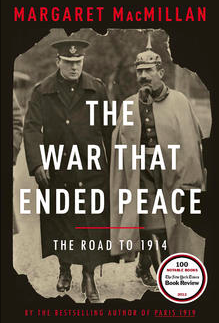

Among the most recent books is The War that ended Peace by Margaret McMillan*, an historian of the University of Oxford. The title seems to dwell on the fact that “Europe had seen no major war for decades before 1914”, only limited conflicts in Asia, Africa and distant regions.
The first chapter has a vivid description of the Paris Exposition of 1900 that was visited by more than 50 million visitors. The French declared the Exhibition as “a symbol of harmony and peace”.
The Introduction, as a stark contrast describe the destruction of Louvain in Belgium, once a “prosperous and peaceful“ gothic town with a famous university founded in1425 with a library that hosted 200,000 unique books. In 1914 the town was destroyed and burned. The author mentions that “like much Belgium, Louvain has the misfortune to be on the route of the German invasion to France..”
The book brilliantly narrates the events that led to the war, the small conflicts and tension between that superpowers and their different allies through the aftermath of the assassination of Archduke Franz Ferdinand in Sarajevo on June 28, 1914, the spark that brought Europe to a war which ended the European empires and caused the worst chaos, death and misery to millions of people, including civilians, children and woman.
Among the fiction books that depict the human side of the beginning of a peaceful 20th Century and the horrible war, Joseph Roth offers two masterpieces, “The Radetzky March (1932) and its sequel The Emperor’s Tomb (1934). In the introduction of the first one, Nadine Gordimer mentions how Roth let us “see the deterioration of a society, an empire, in which disparate nationalities have been forced into political unity by an overriding authority and its symbol: the Austro-Hungarian Empire and the personality of Emperor Franz Joseph.”
“The Radetzky March is the story of a prominent family that was granted the highest ranks of the nobility for an heroic act of a soldier that saved the life of the young Emperor Franz Joseph in a battle. It described the life of the youngest member of the Trotta family and how the Empire was collapsing under the oldest emperor in the world. “All around him, Death was circling, circling and mowing”. The huge power of the Hapsburgs was dying, “shattered on the ultimate bottom of the universe, splintering into several tiny solar balls that had to shine as independent stars on independent nations.”**
Some analysts see a parallel to the conflicts between China and Japan for some minor unimportant islands comparing these with what happened in the pre-war Europe 100 years ago.
I think it is a good timing to remember the First World War and its horrors reading Margaret McMillan’s history book as well as Joseph Roth’s brilliant novels.
>>>
* Margaret McMillan. The War that ended Peace. Random House, 2014. iBooks https://itunes.apple.com/us/book/the-war-that-ended-peace/id653545020?mt=11
* Roth, Joseph. “The Radetzky March.” Overlook Press, 2002. iBooks. https://itunes.apple.com/us/book/the-radetzky-march/id471195709?mt=11
Linking “Against the Current” paper li and “Learning & Sharing”
Posted: February 12, 2014 Filed under: Uncategorized | Tags: Against the Current 1 CommentI am producing “Against the Current” li Paper for the last 6 months, selecting daily five stories that I consider relevant about Books, Culture and Technology that are published by different media outlets. http://paper.li/pintobooks/1377241712#
The process is easy since I read many stories every day on those topics. The platform is great and easy to use. One issues which make it limited is the fact that it did not allow to add any personal comments, just posting the selected article.
Paper li’s platform does all the formatting , including selecting an image from each article and the first few lines of each story.
Paper li allow me to look at the the post before is made public. Is a good option to be able to move selected articles of the day and deciding which will be the leading note. Once I a satisfied the way it looks the Paper li program sends an eMail to each subscriber and also posted the Daily in my Twitter and Facebook accounts.
Now I will see how it work having as one of the notes, reviews made in this site, “Learning and Sharing” that includes personal notes and comments, linking the two sites. https://jpintobooks.com/about/
Lunch with the FT: Ian McEwan By Caroline Daniel.
Posted: August 30, 2012 Filed under: Books, Uncategorized Leave a commentEvery weekend in the Arts Section of the Financial Times there is a special column named “Lunch with the FT” which, more than a regular interview, is an informal conversation between its editors and a relevant author, business man, artist or any person with an interesting public life. Depending on the topic, an editor for one of the newspaper sections hosts the lunch describing the restaurant and the food and at the end even the details of the bill are published. This style offers a glimpse of the taste of the guests regarding food and the way they treats a lunch interview, since some are relaxed, others serious or discrete, etc.
The list of guest is impressive including the Chinese artist Ai Wei Wei, Economics Nobel Prize Winner Paul Krugmann, former head of the European Central Bank Jean-Claude Trichet, Hair Mogul Vidal Sassoon and actors Isabella Rosselini, Dustin Hoffman to name a few.
The lunch with the famous writer Ian McEwan is full of interesting insights of his work and life, including a difficult childhood and family problems. The article talks about McEwan’s work that involves 13 novels including Atonement which was adapted into a film that wins an Oscar.
A recurrent theme in McEwan’s novels is an unexpected event or an accident that changes radically the life of its characters, particularly in Saturday (2006) and Enduring Love (1997). His writings can also be full of black humor with complex personal relationships such as a twist in love affairs as is shown in his novella Amsterdam (1999).
His books also have political content like the environment, the war in Iraq as well as terrorism. Like many other British writers, in the interview he revels his fascination with spies even if “he never wanted to become one”. The latest novel one soon to be published Sweet Tooth is about MI5. The article mentions part of his research for his novels about spies, for which he talked to the famous spy writer John le Carré who he admires for reflecting “the human condition seen through the prism of office politics”,
As a reference, Joseph Conrad, another famous English writer, was also fascinated with these themes of spy and terrorism with his famous novels “The Secret Agent” (1907) and “Under the Western Eyes” (1911).
His new novel Sweet Tooth released in 2012 is well written but I expected more from McEwan.
Craig Brown. Hello Goodbye Hello: A Circle of 101 Remarkable Meetings.
Posted: August 27, 2012 Filed under: Books 1 CommentA book on encounters and conversations, that can be useful to inspire stories and plots. Craig Brown is a columnist for the British magazine Private Eye, with a well-researched collection of conversations between famous characters. Craig Brown gathered these sometime bizarre meetings, expected or unexpected, from different sources. This book even includes an incident of Adolf Hitler being hit by a US student testing his new car in Germany before World War II. There is also an account of a 2-hour visit that Rudyard Kipling made to Mark Twain when the former was still a young follower of the latter whereas years later Twain became an admirer of Kipling. The book is filled with gossips, funny stories and interesting conversations between iconic names including artists, composers, filmmakers and architects, etc. Craig Brown tells us that “Everything in this book is documented…Nothing is invented. When accounts of the same meeting differ, as they almost always do, I have sided with the most likely.
Craig Brown. Hello Goodbye Hello: A Circle of 101 Remarkable Meetings. Simon & Schuster. 2012
Also reviewed by Michiko Kakutani. New York Times, August 2012.
Orham Pamuk, The Museum of Innocence, 2008.
Posted: August 27, 2012 Filed under: Books Leave a commentThe author is the 2006 Literature Nobel Prize winner. In his 8th novel The Museum Innocence Pamuk explores life in Istanbul during the 70s and 80s with particular details from the perspective of the son of a wealthy industrialist. The book vividly portraits the social and moral conflicts of a society, even being ruled by a secular system that broke with Islamic law, which was torn between rigid traditions and the desire to emulate the West. Pamuk emphasizes these tensions through love and pre-marital sex. The book focuses on an obsessive relationship full of pains and difficulties, which for the western readers today might not be easy to understand. His descriptions of spaces including homes, streets and restaurants, as well as feelings of love, shame, greed, hope and despair in situations such as parties and outings full of credible conversations with the most diverse topics ranging from filmmaking to business with lots of social gossips. All these made this book a psychological trip to the mind of an addict lover, as well as a guide to Turkey’s capital.
Related article: Memory Lane by Maya Jaggi, published in The Financial Times, is more of a review of the physical museum with the same name of the novel which was founded by Pamuk in a townhouse in Istanbul’s antiques district to host the objects described in the novel which are associated with its main characters.
http://www.ft.com/intl/cms/s/2/d373494a-7cde-11e1-a676-00144feab49a.html#axzz24B8hpC9i
Introduction
Posted: August 26, 2012 Filed under: Uncategorized 1 CommentLearning and Sharing
“All these are readers, and their gestures, their craft, the pleasure, the responsibility and the power they derive from reading, are common with mine. I am not alone.” Alberto Manguel, The History of Reading
Like millions in our time, one of my daily routines is to read online newspapers, magazines and books, as well as to watch clips with events and interviews. I read the headlines from a selection of international news sites that I consider having a global reach and good sources of the stories that they broadcast, followed by scanning through the financial and political pages.
I also pay special attention to the cultural sections where I look for new books, including literature, film and theater reviews as well as art news. This routine helps me to be current in those fields that allow me to understand what is happening there while expanding my knowledge about the world and the human nature, and enriching my learning experience.
Like any other forms of curatorial activities, my selection is subjective and based on my experiences partly due to the time that I have dedicated to read on-line since its early stages involving the first Mosaic browser back in 1994. I am aware that in this era everyone can be “a reader” and “a writer”. Yet with my participation, I still hope that the notes and links of my personal selection posted in this site can be useful for those who, like me, believe in permanent learning.
Since English is not my mother tongue, I apologize for the sometimes misuse of this beautiful language which allows to communicate with a broader audience.
Jorge Pinto
 Reading and Sharing